

The Connecticut Sun are set to relocate to Houston in 2027, giving the city its first WNBA franchise since 2008.
The news comes as the team was sold to Houston Rockets owner Tilman Fertitta for $300 million. With the team’s relocation, the WNBA is trading its smallest market for the fourth-largest metropolitan area in the country and the largest market without a WNBA team.
Origin of The Connecticut Sun

The Sun originally began as The Orlando Miracle in 1999, before the Mohegan Indian tribe purchased the franchise and relocated it to Connecticut in 2003. Despite its small market, the team was among the most consistent in the WNBA, qualifying for the playoffs in 15 of its 21 seasons.
But, in its 23 years playing at the 10,000-seat Mohegan Sun Arena in Connecticut, the team drew an average of just 6,708 fans per game, typically placing the franchise in the bottom half of the WNBA’s annual attendance figures.
But while the attendance figures didn’t help, the real reason for the move seemed to be the limited upside of the local market. The WNBA has seen a dramatic uptick in interest, and games featuring the Indiana Fever’s Caitlin Clark and the Dallas Wings’ Paige Bueckers are being moved to larger arenas, which wasn’t possible locally in Uncasville. In general, it was going to be more difficult for the WNBA to expand in Connecticut than to move to a larger city.
But why didn’t the Sun move to Boston?

Well, that’s a good question. Reports are that two different regional ownership groups submitted $325 million bids for the team – $25 million more than the Houston offer. Celtics minority owner Steve Pagliuca wanted to move the team to Boston, while Milwaukee Bucks co-owner Marc Lasry wanted to move the team to Hartford.
While it’s not surprising the league would pass on a small market like Hartford, the decision to leave the 10th-largest media market in the country, where the team had an invested and developed fanbase, does leave fans in the New England area with a legitimate gripe, and one they may hold onto if the WNBA tries to expand to the area at a later date.
History of the WNBA in Houston

The Sun’s relocation to H-town restores a team to one of the league’s founding cities. The Comets launched in 1997 when the WNBA began, and went on to become the WNBA’s first dynasty, winning four consecutive league titles from 1997 to 2000.
Beginning in 2001, though, hard times fell on the Comets. In 2006, then-owner Leslie Alexander, who also owned the Rockets, sold the team to Hilton Koch, who promptly announced that the Comets would change home venues from the Toyota Center to the much smaller Reliant Arena. The decision drove away some local fans, exacerbating the team’s financial troubles.
Koch put the team up for sale in 2008, but when a suitable investor couldn’t be found, the WNBA took over the team and ultimately disbanded the Comets in December 2008. In September 2024, reports indicated that Fertitta began talks with the league to revive the Comets, ultimately setting in motion last week’s relocation announcement.
What the move means for fans
Houston already boasts a robust sports scene, and the addition of the Sun will only raise the city’s sports profile. Fans will have an alternate or additional option to baseball during the summer months, filling some of the schedule loss that will be created by the Dynamo when MLS switches to its new schedule
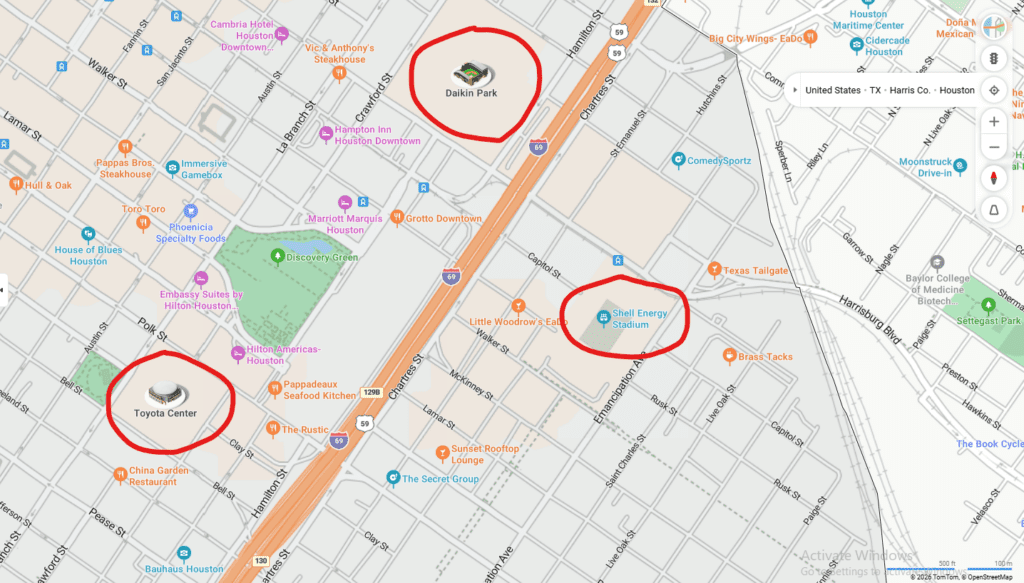
The Comets will play at the Toyota Center, home of the Rockets, which is centrally located in downtown Houston, making attending doubleheaders relatively easy for fans; Daikin Park (Astros) and Shell Energy Stadium (Dynamo) are each within a roughly 15-minute walk from the Toyota Center.
As for Sun fans, well … there won’t be much happiness about this. Fortunately, they have the best collegiate women’s basketball program in the country, just 30 miles down the road.
Next Steps
For local fans who are interested in becoming season ticket holders, you can place a $99 deposit with the team by clicking here. Note: the deposit is non-refundable, but according to the Comets’ terms and conditions, it “may” be applied to your season ticket purchase if you make one. (We think that means it’s very likely they will).
We don’t love the part about the team keeping your deposit if tickets are unavailable or you choose to pass on them – that’s very fan-unfriendly. But the deposit does cover up to four seats, and it’s not a huge investment, so if this is of interest to you, it’s probably a decent idea to sign up.